By clicking “Accept All Cookies”, you agree to the storing of cookies on your device to enhance site navigation, analyze site usage, and assist in our marketing efforts. View our Privacy Policy for more information.
Diaphragmatic Breathing for Strength, Mobility, and Conditioning | Bellbar Strength Lab
Learn how diaphragmatic breathing improves mobility, core stability, and conditioning performance. Discover how breathing better can help you lift stronger and train smarter.
By
March 13, 2026
Related

Diaphragmatic Breathing: The Secret to Better Mobility, Strength, and Conditioning
If you want to move better, lift stronger, and control your heart rate during tough workouts, one skill matters more than most people realize:
Breathing.
At Bellbar Strength Lab, we teach strength using kettlebells, barbells, and bodyweight—but one of the most powerful tools in the gym isn’t equipment.
It’s diaphragmatic breathing.
Learning how to breathe properly can instantly improve your mobility, core stability, strength output, and conditioning performance.
Let’s break down why this matters and how it can transform your training.
What Is Diaphragmatic Breathing?
Diaphragmatic breathing—often called belly breathing—uses the diaphragm, the main breathing muscle located beneath the lungs.
Instead of shallow breathing through the chest and shoulders, diaphragmatic breathing creates 360-degree expansion around the rib cage and abdomen.
A proper breath should:
- Expand the belly, ribs, and lower back
- Keep the shoulders relaxed
- Activate the deep core muscles
- Create internal stability for movement
In strength training, breathing isn't just about oxygen. It’s about creating stability and control in the body.
This is why breathing is one of the first skills we reinforce in our kettlebell and barbell classes.
1. Diaphragmatic Breathing Improves Mobility
Many people assume tight hips, shoulders, or hamstrings are simply a flexibility problem.
Often, they’re actually a tension problem driven by poor breathing mechanics.
Shallow chest breathing keeps the nervous system in a constant stress state, which leads to:
- Tight hip flexors
- Stiff thoracic spine
- Overactive neck and shoulder muscles
When you switch to diaphragmatic breathing, the nervous system begins to downshift into a relaxed state, allowing muscles to release tension.
This is why breathing during mobility work can dramatically improve positions like:
- Deep squats
- Hip hinges
- Overhead mobility
- Thoracic rotation
Instead of forcing flexibility, breathing helps the body let go of unnecessary tension.
2. Breathing Builds Core Stability for Strength Training
Every powerful lift—whether it's a deadlift, squat, press, or kettlebell swing—depends on core stability.
That stability comes from something called intra-abdominal pressure.
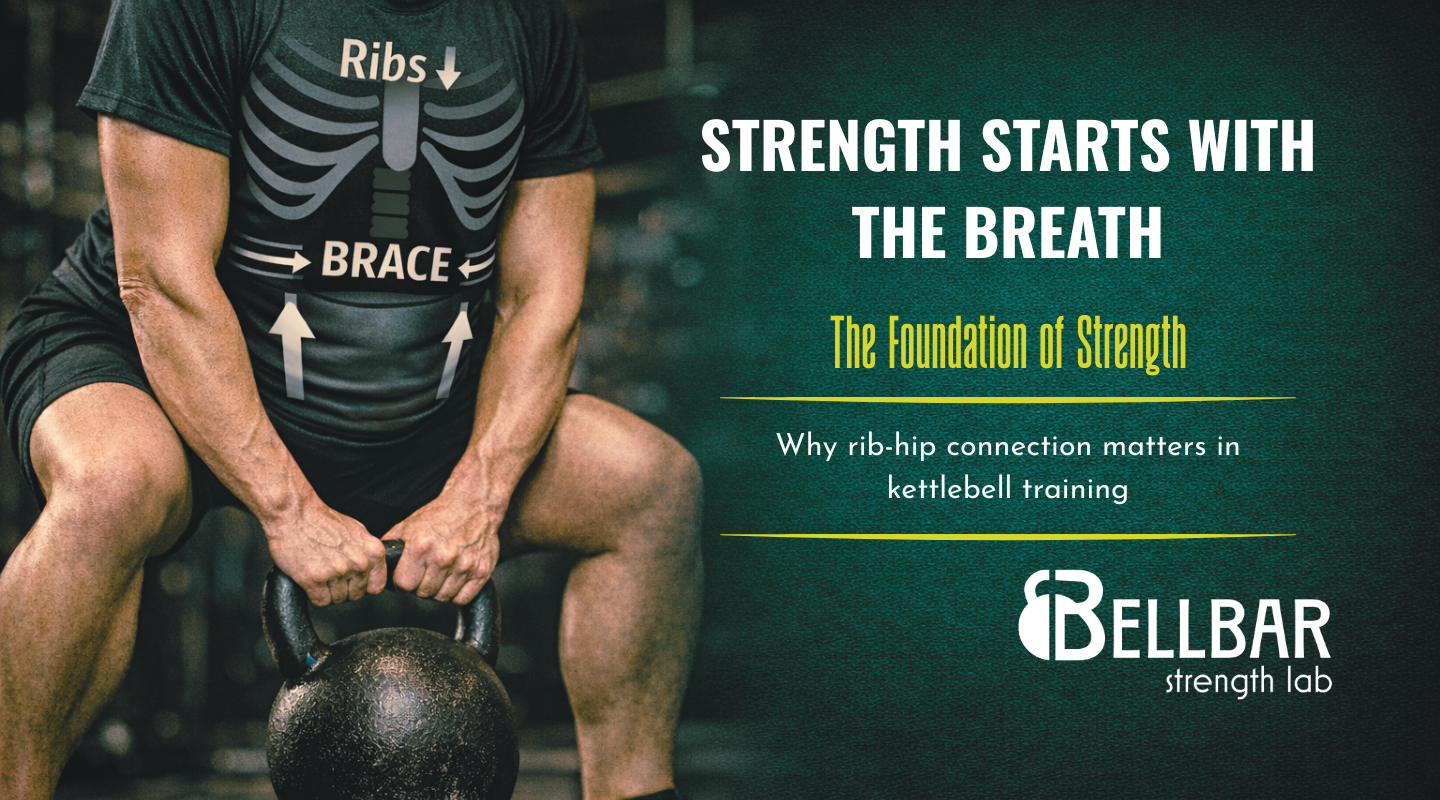
When you take a strong diaphragmatic breath before lifting, your torso becomes a pressurized cylinder:
- The diaphragm sits on top
- The pelvic floor supports the bottom
- The abdominal wall surrounds the sides
This pressure stabilizes the spine and allows force to transfer efficiently through the body.
The result:
- Stronger lifts
- Safer lifting mechanics
- Better power transfer from hips to arms
Without proper breathing, the body leaks strength and the lower back absorbs unnecessary stress.
With proper breathing, your body becomes stable, powerful, and resilient.
3. Breath Control Improves Conditioning Performance
Breathing also plays a massive role in conditioning workouts.
If you’ve ever done high-rep kettlebell swings, snatches, or barbell complexes, you’ve probably experienced the moment when breathing becomes chaotic and your heart rate spikes.
This is where breath control becomes critical.
Intentional breathing helps:
- Control heart rate
- Improve oxygen delivery
- Maintain focus under fatigue
- Recover faster between sets
Athletes in endurance sports, martial arts, and tactical training all develop breath control because it allows them to stay calm under physical stress.
The same principle applies during strength and conditioning training.
Learning to control your breath means you control the pace of the workout instead of the workout controlling you.
Breathing Is a Skill You Can Train
The good news is diaphragmatic breathing is a trainable skill.
You can practice it:
- During warm-ups
- In mobility drills
- Before heavy lifts
- Between conditioning intervals
- Even outside the gym
Over time, breathing becomes automatic and improves how your body moves under load.
At Bellbar Strength Lab, breathing is treated as part of the strength practice, not an afterthought.
Because real strength isn’t just about muscles.
It’s about coordination, stability, and control under pressure.
And it all starts with the breath.
Train Strength the Right Way
If you're interested in learning how to train with kettlebells, barbells, and smart strength programming, we’d love to have you experience a class at Bellbar.
Our coaching focuses on:
- Proper movement mechanics
- Strength for longevity
- Smart conditioning
- Building physical and mental resilience
Because strength should help you move better, feel better, and stay strong for life.